twitter instagram facebook
  • About
  • Contact
  • Food
  • Travel
  • Culture
  • KPOP
  • People
  • Guidebook
    • Seoul
    • Busan
    • Visa Application
  • Resources

Annyeong Korya

Soothing to the ear, a feast for the eyes, calming for the mind, and enriching for the soul, that's how I describe the Korean traditional music and performing arts.

As we are all mainly confined to our homes for enforced quarantine due to the COVID-19 global pandemic, it eventually changed our usual daily routines both inside and outside of our doors. As Korea is doing everything to fully contain the coronavirus outbreak that has gained praises from abroad, the country is once again making a significant initiative to give hope not only to its citizens but also to connect the whole world through the promotion of Korean performing arts and concerts online.
The National Gugak Center in Seoul and Korea National University of Arts along with the Ministry of Culture, Sports and Tourism share series of performances online as part of the 'hope concert' with the aim to promote the Korean culture, support artists in the field, and give hope to everyone in these trying times. ©National Gugak Center
Despite the COVID-19 outbreak, with the offerings organized by the Ministry of Culture, Sports and Tourism along with the most prominent Korean art institutions in Korea including the Korea National University of Arts and the National Gugak Center in Seoul, we can leave our worries for a while, have time for self-care, and learn something new about the Korean traditional music and performing arts without leaving our homes. Through their websites and online channels on YouTube and Naver, these institutions hold series of performances online as part of the 'hope concert' with the aim of not only to promote the Korean culture but also support artists in the field and give hope to everyone in these trying times.

*Samul nori is a percussion quartet comprised of four traditional Korean musical instruments such as buk, a janggu, jing, and kkwaenggwari performed by farmers in villages to celebrate good harvest.

Korean folk music, traditional dances and rituals, or gugak in the local language, such as the pansori, samul nori, nongak, sinawi, and chongak are just a few of the performances that many can enjoy and watch online which are being uploaded daily on various social media platforms. In addition to, yangak music performances such as ballet and showcases that use Western musical instruments like piano and violin are also being posted.


Pansori is a narrative musical dramatically performed by a folk singer and accompanied by a puk drummer. ©KNU of Arts/K-Arts
Korean performing arts is very distinctive and mostly presented through a combination of traditional music and folk songs, ritualistic dances, and fluid storytelling. I am not into folk songs and operas but Arirang, the popular Korean folk song listed as a UNESCO Intangible Cultural Heritage, made me love such genre. Korea National University of Arts alumnus and pansori singer Kim Nani's performance of Sacheolga “Song for Four Seasons” has also captivated my interest as my love for Arirang. Pansori, sometimes called as Korean folk opera, is a narrative musical dramatically performed by a folk singer and accompanied by a puk drummer. The performance was simply beautiful and pleasing as if it would take away our troubles with the wind as we closed our very eyes and listen. A few of the reasons why it is soothing to the ear is the effective singing of the pansori singer accompanied by effective narration and dramatic gestures while in the rythmic setting of the puk, or the double-headed drum used in this folk song repertoire.

*Sinawi is a Korean traditional shamanistic music performed by an ensemble of musical instruments.

While Korean folk music is something pleasing to the ear, these wonderful performances also provide a sense of calmness for the mind and body which is why we all need such showcase amid the life chaos we face today. A registered UNESCO World Cultural Heritage, the sinawi presented by the National Gugak Center will definitely help to bring some peace and calm ourselves in the moment. Sinawi, or spelled as shinawi at times, is a Korean traditional shamanistic music performed by an ensemble of musical instruments such as the two double-reed bamboo oboe (piri), two-stringed zith (haegeum), hourglass drum (janggu), large bamboo transverse flute (daegeum), and large drum (buk), following the principle of sam-hyeon-yuk-gak, but sometimes it also accompanied by gayageum and geomungo. It is usually performed during a shaman’s ritual dance ceremony to entertain the deities and the Gods. With its origin, I find it charming as the contemporary music it creates can kindle emotional connections, can inspire people, and provide the relaxation we need during this time.

*Korea National University of Arts student Kim Dong-hyun's dance performance of “Boy in Blue Suits.. Asks How Are You Doing.”

*The Namwon National Gugak Center’s soothing sinawi showcase.

Additionally, as we enjoy these classic forms of Korean music, performances such as Korea National University of Arts (Department of Dance Performance) student Kim Dong-hyun's performance of “Boy in Blue Suits.. Asks How Are You Doing” and the sinawi ensemble showcase of the Namwon National Gugak Center can also stir good thoughts and new hopes to enrich our soul while letting go of anxiety, our worries and fears about the COVID-19 pandemic. If you also want to get your day livelier, there are also samul nori performances which are interactive and lively in nature. Samul nori, which has its roots in pungmul and customarily performed by farmers in villages to celebrate good harvest, is basically a percussion quartet comprised of four traditional Korean musical instruments such as barrel drum (buk), a janggu drum, a gong (jing), and small gong called kkwaenggwari. The costumes, music, folk dance, acrobatics and rituals make samul nori an extraordinary performance to keep us all entertained.

The beauty and elegance of hanbok were also showcased in all of the performances including the integration of arts in calligraphy, painting and embroidery. ©KNU of Arts/K-Arts
Korean performing arts is also a feast for the viewers’ eyes as performances are not just about the beautiful songs and dances but also the incorporated visual arts to add more appeal and make the storytelling more effective. With great attention to costumes, the beauty and elegance of the Korean traditional clothing hanbok were also showcased in all of the performances including the integration of arts in calligraphy, painting and embroidery with meticulous details. A wide array of hanbok, from the most common ones and official yangban clothes to royal hanbok dresses, were presented and are captivating in both colors and patterns. Korean performing arts is indeed stunning as everything is a visual experience for the audience.

As we all battle to contain the coronavirus, creative ways like these K-Art hope concerts and online performances can help us cope with the COVID-19 pandemic. Stay at home, obey those in authority, relax and free your mind from stress. Even if we are confined to our homes right now, it is not the reason for us to lose hope as we are all in this together and we will soon be able to overcome it.

The Korea National University of Arts kicks off its online concert series on March 11 and ends until March 31st. While the National Gugak Center started posting their online concerts on March 17 which will include about 11 performances from the traditional and folk music groups Jeongakdan and Minsokakdan respectively.

*This article was both published on the Talk Talk Korea (“[K-Arts Review] Korean arts in these trying times,” March 20, 2020) web portal and Korea.net (“[Stay strong, Korea] Online videos of traditional arts offer relief amid outbreak,” March 20, 2020). All screen capture photos included in this article are property of the Korea National University of Arts and the National Gugak Center which are protected under applicable copyrights.
22 March No comments
The most efficient way to promote and share beautiful stories about an inviting country is to experience it firsthand. With series of travels in Korea, I have lots of happy and unforgettable experiences to share, as it wasn’t only my first in the “Land of the Morning Calm” but most importantly I have made new friends throughout the tour.

In late October, I was fortunate enough to have had the opportunity to travel to Korea with my fellow Korea.net honorary reporters during the autumn. We were invited by Korea.net, which is under the Korean Culture and Information Service (KOCIS), for a week of exciting tour of various scenic spots and must-visit places around the cities of Seoul, Busan and Tongyeong.

With our first two days well-spent in Korea’s beautiful capital, our tour itinerary took us to Busan. Our experiences in the ‘Dynamic City’ were as exciting as the ones we had in Seoul, as Busan is situated attractively right on the coast and at the southeasternmost tip of the country.


The metropolis of Busan is the second largest city in Korea after Seoul, and is known as the main seaport of the country and the fifth busiest port in the world by cargo tonnage.

Just like Seoul, the dynamic city of Busan is also rich in the arts, tradition and history, as well as having some of the most beautiful and worth-visiting tourist attractions in the country, such as the Haeundae Beach (해운대해수욕장), Beomeosa Temple (범어사), Jagalchi Market (자갈치시장), Yeongdodaegyo Bridge, (영도대교) and Taejongdae (태종대).

It was a fine day when we left our hotel in Seoul for Busan. Upon arrival at the Seoul Station, we were welcomed by an impressive modern structure that reminded me of the airport at Incheon where it’s as well a world-class facility. As one of the remarkable places featured in the hit movie “Train to Busan" (부산행, 2016), for me, it truly made our tour amazing, enjoyable and all the more special.

It took us two and a half hours on the very accommodating KTX train from Seoul to Busan. Although it was a long tiring trip, we didn’t notice the time but instead the many exciting activities prepared for us at our destination.

Arriving at around 1:30 in the afternoon, we were then greeted by our ever-smiling tour guide at Busan Station. After a short walk from the train station to the waiting area for our bus, we headed right away to our first stop in the city as we had a really tight schedule that day.

Just as fascinating as our tour guide said, the picturesque Gamcheon Culture Village (감천문화마을) is, indeed, stunning at first glance as it’s located in a picturesque geographic location.


The first stop we had on our tour in Gamcheon-dong was the Little Museum, an old house turned into a gallery, which showcases the past and present of the neighborhood. It offer visitors and tourists a glimpse of its historical significance to Korea through pictures and timelines including exhibits of old household items donated by residents themselves.

Gamnae was the old name of the then neighborhood of Gamcheon, which originally meant "sweet water." The word gam is derived from geom which means "God," while nae is a Korean pronunciation of the word cheon, a Chinese word meaning "a small river.”

It was interesting to learn that the place started as the first habitat of believers of Taegukdo, a religion based on the ideas of Jeungsan. Refugees from the Korean War and Bandal Pass, situated between the mountains of Cheonmasan and Amisan, settled there nest here. Throughout the years, they built their homes on the hill itself and formed a small community that later contributed to the progress and development of today's Gamcheon.

The Gamcheon Culture Village is a unique neighborhood built in a stair-like pattern and composed of houses that are lined up quite orderly so as not to block the view of the other structures surrounding them.

Walking along the alleyways of Gamcheon-dong will give you not only a great view of the village but also a glimpse into the daily life of the welcoming community. In the neighborhood, you'll get up close with the many pastel houses in different sizes, colors and designs, which are really distinctive from one another and have their own respective beauty. Other than the structures, you will also see art installations as you walk the alleys which show the creativity of the community. Some of the masterpieces you wouldn’t want to miss and you can have beautiful set of postcard-worthy photos include the Becoming One, Fish Swimming Through the Alley, Sweet Rest, Little Prince and Fennec Fox, Our Town Gamcheon, Mongi and Beanpole, Village Wriggling, and the Autumn Journey.


With its maze-like alleyways, colorful houses and attractive works of arts by renowned artists and residents, the Gamcheon Culture Village continues to attract thousands of tourists each day.

Aside from the creatively-designed structures, there are also art shops and galleries in the neighborhood that sell some of the most amazing artworks in town such as ceramic wares, woodworks and naturally dyed textiles. Some of these studios also offer workshops to visitors for them to experience first-hand how a work of art is made.

Our tour guide led us to the Haneulmaru observatory (하늘마루), which is really a must-see for every visitor. At its rooftop, you get to see panoramic views of Gamcheon including the lush mountain of Yongdusan as well as the busy ports of Busan and Gamcheon. A breathtaking scene where you can have your souvenir photos and selfies against the beautiful village, great mountains and the blue sea.


While an hour of walking makes your feet tired, there are also photo spots along the way where you can rest and sit while taking pleasure in the neighborhood's most breathtaking views. Besides, if you get hungry, there are as well restaurants and food stalls where you can delight in some of the best delicacies of Gamcheon. One of those is ssiathotteok (씨앗호떡), a fried bread stuffed with sugar and mixed nuts. You really have to try this version of hotteok as it’s one of Busan’s most sumptuous street foods.

Usually referred to by locals as the "Korean Santorini," Gamcheon-dong has its own charm and beauty, as some of the most famous TV shows and movies were filmed and set right in the attractive neighborhood: "Hero," "She Came From," "Camelia," "Never Ending Story," "Man From the Equator," "Running Man" and "The Return of Superman," to name a few. It’s no wonder the Culture Village of Gamcheon was officially designated as a "third house of cinema" by Seanema Busan, another reason that the place is worth a visit when in the city.

Through its past, Gamcheon-dong contributed significant progress to the history and society of Korea most especially during the Korean War. You can even see traces of the village's olden times as you walk through its alleys.

Besides the vibes of its timeworn streets, it was also exciting to learn that the neighborhood holds the annual Gamcheon Alley Festival where in exciting market encounters, art exhibitions and performances take place.

Furthermore, with the initiatives and resourcefulness of the residents and community as a whole aiming the continuous improvement and enrich tourism in the village, you can see that Gamcheon-dong is truly a neighborhood with a kind heart.

An hour and a half wasn’t enough for us to tour the entire Gamcheon Culture Village. Although we hadn't been to all of the interesting spots, the experience that we had gave us overwhelming surprise and amazement. The warm people, delicious food and scenic place made our visit a cherished one.

"Busan's scenic Gamcheon Culture Village" was first published in the Korea.net blog. All photos included in this article are property of Annyeong Korya and protected under applicable copyrights.
01 February No comments
Today is Seollal—one of the most celebrated traditional and national holidays in Korea. While the majority of the countries across the globe are observing the New Year every 1st of January, Koreans celebrate the beginning of the year on the second new moon after the winter solstice which in general is around January or February and usually lasts for three days: the day of, before and after the Korean New Year.

This year, Seollal falls on January 25 in which the celebration of the Lunar New Year is particularly special as we will all welcome another decade with the ‘Year of the White Mouse.’ Based on the twelve animal deities, the mouse is the first animal guardian in the deities generally known as Sibijisin, or the ‘Twelve Gods of the Earth,’ which changes every year over the cycle of 12 years. Characterized by the rodent’s wit, cleverness, intelligence and flexibility, 2020 will be about fortune and personality.
A set of traditional Korean rice cakes which include  injeolmi (rice cakes coated with roasted bean powder), gyeongdan (rice cake balls made of glutinous rice flour and filled with various sweetened fillings), and yaksik (Korean sweetened rice bars with dried fruits and various nuts).
Seollal traditions, family customs and foods

Seollal is considered as Korea’s most important family occasion in which many Koreans leave the city to spend the holidays to travel and visit their families and relatives in their hometowns. During this time, every family pay respect to their ancestors through an ancestral rites called the charye which is traditionally observed early in the morning of the official day of Seollal. All family members and relatives in their traditional Korean dress hanbok, or special dress for the occasion, gather to perform this important practice of the Seollal customs and traditions that many Koreans value up until this day. The ritual begins with the preparation of traditional foods that are set on the table as offerings. Common ritual foods include rice, rice cakes, meat, dried fish, fruits, vegetables, and traditional liquors. As the table for charye is set, in the order of the oldest to the youngest, all family members perform traditional bows to pay respect to the spirits of their ancestors and pray for the well-being of the family. Following the ritual of bows, the family gathers to feast on the food prepared for the rites and for everyone to enjoy.

After the ancestral rites, the younger ones will give their parents and the elderly gratitude and their New Year’s wishes through a deep formal bow or formal greeting custom called the sebae. The elders will then give their children Seollal gifts in return which they often receive sebaetdon, or the New Year’s money, placed in an embroidered fortune pouch bokjumeoni, in addition to their blessings and or words of wisdom called dokdam in the local language.

Besides the ancestral rites, Seollal is also about family bonding wherein Korean families spend the rest of the holidays playing fun games such as the popular traditional family board game yutnori which is played with tokens and four wooden sticks, the pitch-pot tuho, hacky sack-like kicking game jegichagi, spinning Korean paengi tops, and other exciting activities as flying of kites called yeonnalligi for boys and jumping on a Korean seesaw neolttwiggi for girls; eat some more food, and catch up with family, relatives and friends by sharing one’s life stories.

A non-Korean’s celebration of Seollal through food

Celebrating the New Year is what I also look forward to each year besides the series of family birthdays and the holiday seasons. Although we traditionally observe the special occasion every January 1st based on the Gregorian calendar, it has become accustomed for me to prepare some traditional Seollal food to welcome the Lunar New Year, which falls on the same day as the Chinese New Year, or the Spring Festival, which is often celebrated by many Filipino-Chinese in the Philippines.

Every family occasion, I am the one who cooks along with my mother and that is why I am considering the kitchen as my second home. Since cooking is one of my hobbies and I love Korean food, I am also keeping myself busy cooking my favorite Korean dishes when Seollal comes. What are the traditional Seollal dishes that I usually cook then? Get your aprons ready and let your cooking pans heat up for some delicious traditional Korean food prepared for the Korean New Year.

First on my list is the Korean rice cake soup tteokguk, one of the representative dishes traditionally served for Seollal. The common ingredients of tteokguk include the beef brisket, thin slices of garaetteok rice cakes, spices such as garlic, onions, green onions, and whole black peppers, soup soy sauce and salt to taste, and also roasted dried seaweed gim and egg strips as garnishes. For me, preparing this most symbolic Seollal dish is quite laborious as it requires considerable effort and time to come up with a clear and tasty beef broth as it will be the soup base of the dish. The beef needs also to be tender enough to shred as toppings for the soup and which will give the tteokguk its savory taste and will compliment the chewy texture of the thinly sliced ​​rice cakes. As tteokguk varies by region, some also give the soup some twist by adding up Korean dumplings which will further enhance the flavor of the rice cake soup. Tteokguk’s clear broth is believed to clean the mind and body while the ​​rice cakes which resemble as coins is said to symbolize prosperity. Moreover, eating a bowl of tteokguk is part of the tradition and is similar to a birthday for many Koreans as it symbolizes growing a year older in the New Year.
Tteokguk, or Korean rice cake soup, is the most symbolic dishes traditionally served for Seollal. Eating a bowl of tteokguk is part of the tradition and is similar to a birthday for many Koreans as it symbolizes growing a year older in the New Year
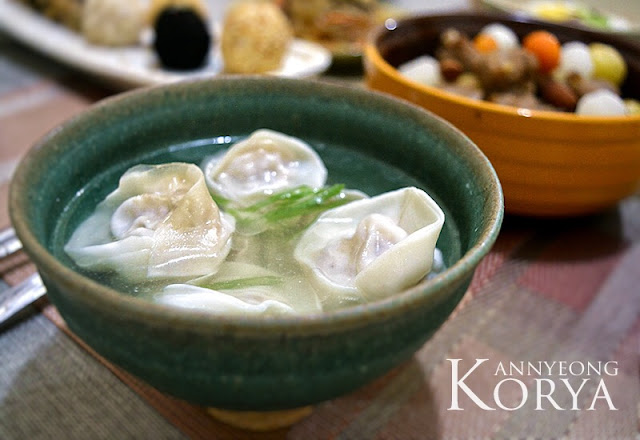
Besides the delicious soup, I sometimes make homemade Korean dumplings mandu in which it is a symbol of good luck for the coming year. Making mandu for me is easy but it’s also time consuming as you need to wrap all the mixture into small half-moon shape dumplings. I know some of you want it fried but I prefer my Korean dumplings to be steamed as the usual and or make it into Korean dumpling soup manduguk which is also a popular food for the New Year.
A bowl of delicious manduguk, or the Korean dumpling soup.
As Seollal is such a special occasion, galbijjim is also present at our dining table. It's a classic meat dish that is cooked by braising beef short ribs in sweet and salty sauce. The preparation of this dish is as well very tedious and require hours to cook as it is necessary to repeatedly boil the short ribs with various spices until the broth is clear and the meat is tender. After boiling, the cooked short ribs are braised with a special rich sauce along with radish, carrots and sometimes potatoes that are cut into chunks of balls to usher in good luck. Galbijjim is usually served with a garnish of roasted chestnuts or various kinds of nuts to add texture to the dish. I can say that galbijjim is a family’s favorite as every time I am serving it for dinner, they all love it especially if it’s paired with freshly steamed white rice.

Another dish that I always prepare for the occasion is the Korean glass noodles mixed with beef and vegetables called japchae. It's quite similar to the all time Filipino favorite pancit, or stir-fried bihon noodles, in which the taste is also full of flavors. Although japchae is slightly sweetened with sugar and seasoned with sesame oil, the Filipino stir-fried noodles which also has vegetables and shredded boiled chicken is rather savory and the way they are prepared is a bit different. While japchae is considered a side dish and an appetizer, it is also a balanced and an auspicious Korean dish in which the noodles symbolizes long life and the combination of colorful ingredients such as the sautéed dried mushrooms, white onions, bell peppers, carrots, and blanched spinach with garnishes of fried egg strips and roasted sesame seeds symbolize prosperity. Japchae is always present on most Korean holidays and special occasions so don't forget to have some this Seollal.
The Korean glass noodles stir-fried with beef and vegetables, or japchae in the local tongue. It is considered an auspicious Seollal food in which it symbolizes long life and prosperity.
There are also many kinds of jeon, or traditional Korean pancakes, that I usually cook to celebrate the New Year like the pajeon (green onion pancakes), haemul pajeon (Korean seafood pancake), and hobak jeon (pan-fried Korean zucchini fritters) to name a few. They are basically savory pancakes made out of egg batter mixed with either chopped stalks of green onions, seafood such as clams, calamari, and oysters, or slices of zucchinis, and then it's pan fried. As these jeon are quite bland, they are enjoyed with a special dipping sauce usually a mixture of soy sauce, vinegar, sugar, sesame oil, and roasted sesame seeds.

Also, I always make sure to serve a complete meal for my family so I am as well serving them with traditional Korean rice cakes such as injeolmi (rice cakes coated with roasted bean powder), rice cake balls gyeongdan which are made of glutinous rice flour and filled with sweetened fillings as red bean and sesame paste, and even the medicinal food yaksik, or Korean sweetened rice with dried fruits and nuts, that is actually nutritiously delicious. I am usually pairing these traditional desserts and confections with my favorite sujeonggwa, a traditional cinnamon punch made from boiling cinnamon, slices of ginger, and gotgam (dried persimmon) which is then garnished with some pine nuts.
Glasses of sujeonggwa, a traditional Korean cinnamon and persimmon punch, which is best paired with desserts and confections like injeolmi and gyeongdan.
Although the preparation of this set of traditional Seollal food takes a lot of time and hard work, for me, it is really worth the effort seeing your family enjoying all the food you have prepared for them. This Lunar New Year, I will cook some of these dishes again as this is my own way of sharing the inviting food culture of Korea that I have learned to love through the years.

I hope that you enjoyed and learned something new with this Seollal feature. On the occasion of the Korean Lunar New Year, please eat a lot and spend much of your time well with your family during the holidays. With the start of a new decade, I wish that 2020 may bless each and everyone of you abundance of health, wealth, and happiness. 새해 복 많이 받으세요!

*This article was first published on the Talk Talk Korea (“Let’s cook for Seollal: A celebration of traditional Korean food overseas,” January 23, 2020) web portal. All photos used herein are property of Annyeong Korya which are protected under applicable copyrights.
25 January No comments
Museum is a place we can all visit to appreciate, learn and travel through history. It is where we get a lot of information and have a glimpse of the people's lives, the kind of society they have and the important historical events that happened in the olden times through the artifacts on display. They are, of course, astonishing pieces that have survived time so people of the modern age can also explore and have a wider knowledge of the past. I have already visited many museums which always cultivate my sense of amazement as it guides me to cultural heritage and history but one stood out from the rest.


One of the exciting activities I definitely enjoyed when I got to visit Korea few years ago that gave me a remarkable experience to travel back in time and see a portion of Korea's rich history was our visit at the National Museum of Korea. Situated in the capital city of Seoul, the history and art museum represents Korea as a whole wherein it harmoniously blends traditional and contemporary styles through the exhibitions of artifacts and art pieces from notable periods. The three-floor museum was the first modern museum I've been to where it is said to be the world's sixth largest museum in terms of floor space that attracts millions of visitors annually. It houses over 300,000 pieces of treasured artifacts and relics from different periods in which some are on display in six permanent exhibitions which include the galleries of the Pre-history and Ancient History, Medieval and Early Modern History, Donation Gallery, Calligraphy and Painting Gallery, Asian Art Gallery, and the Sculpture and Crafts Gallery.

Crowd of students fill the exhibition hall entrance of the National Museum of Korea.

The national museum is divided into two exhibition buildings where its left structure symbolically represents the past and the right part represents the future. Just in front of the modern museum, especially on the ground floor, the structure is landscaped with inviting gardens and parks where it's fenced with plants and trees that often add beauty to the place during the beautiful seasons of spring and autumn. As the museum is divided into floors, it's quite huge so you need to spend a day to tour all the galleries and enjoy other amenities nearby the museum’s park.

It was autumn when we paid a visit to the National Museum of Korea so basically the surroundings were full of colors set in a pretty cold season. You will immediately notice the grandeur yet minimalist architecture of the museum when entering the great hall which serves as a reception and information desk for visitors. From there, you can rent out audio visual devices that provide artifact commentaries and serve as your digital guide that you can use to interactively tour all the galleries which is in major languages such as English, Chinese and Japanese. It was my first time to use a digital guide in a museum so the tour came in handy for me as it really is easy to use. If you are not into tech though, you don’t need to worry as besides the audio visual devices there are as well guided tours for everyone including tours in sign language.

Framed soil relics illustrating the early Korean pottery’s advancement in the olden times.

The first floor of the museum is divided into three gallery exhibitions namely the Pre-history and Ancient History, Medieval and Early Modern History, and the Thematic Exhibition. From the great hall entrance, we will begin our journey through time and explore the early periods of Korea's great heritage and history. Basically, the first part of the museum features the origin of the Korean culture from the Paleolithic Period to Bronze Age where it is followed by the ancient realm of Buyeo to Goguryeo Kingdom until the Three Kingdoms of Baekje, Gaya and Silla to the period of Unified Silla and the Kingdom of Balhae.

Exhibition display of an ancient warrior of the Confederacy of Gaya.

Enclosed in a glass case are the metal movable type that was once used by the royal court and the government offices during the Joseon period which is considered the largest collection of such kind in the world.

The relics and artifacts that are on display in numerous exhibition rooms in this floor were excavated from various sites across Korea where it ranges from dig out remains of human clay figurines, pottery developments, stone axes, bronze-made mirrors, gold crowns and royal ornaments, several patterned bricks and roof tiles, metal helmets and armours, the old armaments such as spearheads, swords and arrowheads to a grand replica of the mural paintings found in a royal tomb. The set of galleries showcase the early settlers’ progress in their lifetimes until the early civilization. Besides the ancient artifacts of the early periods and the special exhibition, important cultural artifacts of about 1,900 pieces from the Goryeo and Joseon Dynasty are also displayed here which I can say was my favorite part of the museum. In these galleries you can find historical heritage of the Korean dynasties and restored artifacts such as Buddhist-inspired art pieces and the bronze images of the Great Buddha, the impressive ten-story high pagoda sculptured with intricate designs that were originally erected at the Gyeongcheon Temple from Goryeo which is also Korea’s national treasure, including the replica of the vast map of the Joseon-built palaces. One that captivated me most and considered the highlight of the gallery is the largest collection of movable type in the world which is created during the grand era of the Joseon dynasty. More than 820,000 pieces of movable type have survived until this day and half of which is made of metal. They were once used by the Joseon royal court and government offices from the 17th to early 20th centuries and considered unique of its kind in the world.

A letter in Hangeul written during the Joseon dynasty which is exhibited at the Calligraphy and Painting section of the museum.

Scroll paintings depicting life, people and society during the old days of Korea.

Besides the cultural heritage that is showcased in various periods and dynasties, there's no reason to not appreciate at the other galleries. The museum’s second floor is divided into two exhibit galleries specifically the Donated Gallery and Calligraphy & Painting Gallery. Compared to the first collection which centers on the prowess of Korea’s old eras, it contains thousands of valuable works donated by private collectors from around the globe which are exhibited in ten gallery rooms. Artifacts such as beautifully designed white porcelain jars in various sizes and shapes including a number of antique Buddha sculptures are just few to be amazed at. In addition to, old precious seals, inscriptions by known calligraphers during the Joseon period, various Korean traditional paintings in scroll and folding types, and other art pieces related to Buddhism are also found here. I can say that one of the highlights of the collection is the Stele for the National Preceptor Nanggongdaesa originally erected at Taejasa which consists of exquisitely inscribed scripts made by Unified Silla's well-known calligrapher Kim Saeng, one of the four great masters of calligraphy in Korean history. Furthermore, there are also display collections of personal letters written in the Hangeul alphabet by well-known personalities of the Joseon dynasty, realistic paintings depicting life and society of the olden days just as the Album of Genre Painting by the 18th century painter Danwon, wood and lacquer-made crafts in which some were inlaid with mother-of-pearl, as well as the process of making and replicating old painting portraits for restoration purposes. Whether you are into the arts or not, you will definitely appreciate Korea's old society, its people and their heritage through these masterpieces. There really is a lot to learn in these galleries so getting lost figuratively is just a good idea as all of the artifacts on display are interestingly rich in history. In the collection of Calligraphy & Painting, artifacts and displays are usually rotated with different art sets to preserve them from damaging so there's something to look forward to every time you visit the museum besides the permanent exhibitions.  
The iron seated Buddha made during the Unified Silla is housed in the Ancient History Gallery of the National Museum of Korea.

On the third floor is where a collection of Asian Art and the galleries of Sculpture and Crafts from other countries are located. It features 1500 artworks and cultural treasures gather round from Asia to showcase the similarities of cultures and uniqueness of the Asian cultural heritage. From white porcelain made vases and celadon wares like the 12th century old Celadon Incense Burner with Openwork Design which is as well a national treasure of Korea, to various metal art crafts and other important relics that recovered from a shipwreck, each of the time-worn artifacts indeed has its own place in the history of the country it represents. Besides, the gilt-bronze Maitreya in Meditation and Amitabha Buddha which are Korea's national treasures are exhibited here which showcase the astounding craftworks and expertise of Korean artisans in their times.

Korean students having their educational tour along with their guide at the National Museum of Korea.

As a place of knowledge, it also offers diverse cultural and educational programs for everyone most especially for families, children and students. In fact, on the day we visited the museum there were crowd of students touring round the galleries for their educational activity so it’s particularly a perfect place for learning. Moreover, there are also outdoor exhibitions to anticipate about such as the pagodas and stone monuments including the national treasure Bosingak Bell made during the Joseon period.

Visiting the museum is like traveling back through time where you can be a part of history through the artifacts that are on exhibit display. You will definitely enjoy every piece of history inside the National Museum of Korea. I miss out on some of the galleries particularly on the last two galleries as we have limited time to tour the museum and to tell it’s really huge so there's another reason to visit again. In my experience, it was the first museum that I visited outside my country which impressed me a lot as it also has modern facilities like digital information booths, library, video rooms, theatre, lounge, public phones, café, restaurant, museum shop and even rental service for strollers and wheel chairs for the convenience of visitors.

The National Museum of Korea is open all week long including holidays in which admission fee is free for the public. It is easily accessible through the Seoul subway so don’t forget to include it in your travel bucketlist when in the capital city. For more information and advance online reservation of tickets, you can visit the museum's official website at www.museum.go.kr.

How to get there?
By subway, take Line 4 or the Jungang Line (Munsan-Yongmun) to Ichon Station. Get to Exit 2 and walk around 150m toward Yongsan Family Park.
Address: 137, Seobinggo-ro, Yongsan-gu, Seoul 서울특별시 용산구 서빙고로 137 (용산동6가)
11 June No comments
Korea is beyond a doubt invitingly beautiful in any season. Besides the colourful autumn, it’s also the best time to travel to the country during the spring because of the fine and good weather.

The Korean peninsula has four distinct seasons and each lasts about three months. A relatively hot and humid summer with monsoon rains begins in June and runs until the middle of July. The pleasantly warm and sunny weather of autumn runs from September through November. The generally cold, dry and windy winter begins in December and goes until the end of February. Finally, the significantly wet and cool season of spring is in the months of March, April and May.

The season’s fading doesn't mean it’s the end but instead it's a hope for new beginnings. It's just like the transitioning of the snow-covered mountains into a flourishing sanctuary of flowers every the beautiful spring.

Cherry blossoms begin to flower welcoming the beautiful season of spring.

Springtime in Korea is considered by most people to be one of the best seasons in which it's worth to plan your trip as most of the lovely blossoms and buds start to grow and bloom along the roads, in the wide fields and on the mountainsides.

As beautiful as the color palettes of autumn, spring is as well treasured, as grass, plants and trees of different kinds sprout their leaves and burst into different hues of green, pink and red, especially if the cherry blossoms are in full bloom.

During the peak of spring wherein all the cherry and plum blossoms showcase their beauty and usually last only a week, people flock to the best spots and attractions to witness the white and cherry-pink blooms as some of the petals rain down to earth.

Spring flowers like forsythias, canolas and cornelian cherries border the streets, parks and villages in bright yellow, while the buckwheat sprouts and royal azalea blooms blanket the fields and great mountains with tints of olive and purple.

Another reason to enjoy the lovely springtime of Korea is the various exciting festivals that many locals and tourists alike is looking forward to each year. One of these popular festivals, actually the biggest and most-visited every spring, is the Jinhae Gunhangje Cherry Blossom Festival 진해군항제 which continues to attract millions of people just to see and laze around the thousands of sweet-scented blossoming Korean cherry trees. It’s held in Changwon in the historical province of Gyeongsangnam-do.

Crowds of people enjoy the cherry trees in blossom at Seokchon Lake.

Moreover, other famous spring festivals take place across the country, as early as the first week of April, which are also well-worthy of a day of travel. There's the Gwangyang Maehwa Festival with its flourishing plum blossoms, the Gurye Sansuyu Festival in which the wide fields of cornelian cherries bloom in hues of yellow under the spring sun, and also the Jeju Cherry Blossom Festival showcasing the pink blossoms of the famed island. Also, the Goryeosan Mountain Festival where the entire mountainsides of island of Ganghwado are filled with newly flowered wild azaleas.

Associated with spring, pink plum blossoms start to showcase their beauty and give off a spring fragrance as lovely as the cherry blossom trees.

The grand Joseon palaces are also considered to be some of the best tourist spots to visit in the spring. Imagine a flourishing cherry blossom tree waving over a pond adorned with carp and lotus flower along with the wooden-made palace. Isn’t it a picturesque landscape to muse to? Not to mention, the butterflies and bees busying themselves collecting some pollen which adds to the spring ambiance.

Koreans in elegant Hanbok poses for a picture at the grand palace of Gyeongbukgung adorned with lovely cherry blossom trees.

With landmarks, the palaces and great mountains show signs of spring, it’s also the best time to go on a family picnic and to pay a visit to some of the best cherry blossom-lined roads in Seoul such as the Hadong Park Simni and the pathways along the Yeojwacheon Stream, including the Yunjung-ro Cherry Blossom Road in Yeouido Hangang Park.

While enjoying the beautiful scenery, good weather and spring festivals, it’s also a must to try some special spring treats, such as rice cakes and punch made with azalea petals while as well taking part in the samjitnal 삼칟날, a custom where the Joseon royalties with the help of the court servants enjoy cooking rice cakes decorated with various edible flowers, as well as making a refreshing punch out of omija seeds, honey and some pine nuts.

Beautiful rice cakes made with azalea petals make us appreciate the sweet taste of spring.

It’s no wonder that spring in Korea is as splendid as the foliage of autumn. No matter which season you choose to visit Korea, all year round your travel experience will be for sure a cherished moment.


"Experience the blooming of spring in Korea" was first published in the Korea.net blog. All photos used herein are from the official Flickr page of the Republic of Korea which are for general educational and informational purposes only. All other forms of media included in this article are property of their respected owners and protected under applicable copyrights.
23 April No comments
Newer Posts
Older Posts

Travel Geek

Travel Geek

Annyeonghaseyo!

I am Jap, a Korea.net Honorary Reporter based in the Philippines. The geek behind this Korea centered web hub. Come along with me as I map the inviting countryside of Korea, try [even cook] delicious Han food and experience the best of Korean culture.

Gajaaa, let's discover Korea beyond kimchi!

Follow AK

Today’s Trend

Created with by ThemeXpose